

“He who has ears, let him hear.”
— Matthew 11:15
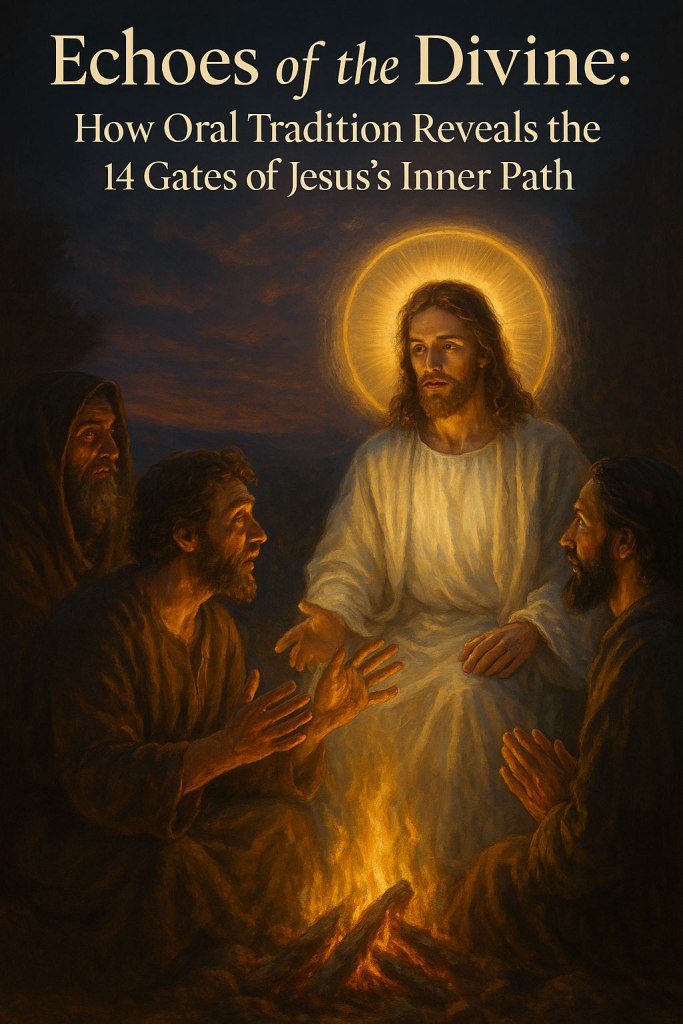
The sayings of Jesus were not merely words, but gateways to awakening. Passed first through the oral stream—living breath to living soul—they carried not just information, but transmission. Over time, as these sayings were written down and layered with interpretation, they became mirrors reflecting the stages of soul evolution now understood within the Gatian Path of the 14 Gates.
Rather than viewing these variations as distortions, we can now see them as multifaceted expressions of the spiritual climb—each version echoing the needs and understanding of different initiatory levels along the journey toward divine sonship.
The Lord’s Prayer — Gate 3: Levi, Priest of the Word
Matthew 6:9-13 vs. Luke 11:2-4
“Forgive us our debts…” / “Forgive us our trespasses…”
Luke’s shorter version represents the raw essence of prayer—spontaneous communion with the Father. Matthew’s expanded version reflects the ritualized invocation of the early priesthood, aligning with Gate 3: Levi, where sacred speech becomes priestly offering.
In Gnostic terms, the Gospel of Philip emphasizes that words spoken in spiritual alignment become vessels of light:
“Truth did not come into the world naked, but in types and images.”
Every word of the Lord’s Prayer is a mystical key when uttered from the Gate of inner silence.
Blessed are the Poor” — Gate 9: Issachar, the Burden Bearer
Luke 6:20 vs. Matthew 5:3
“Blessed are you who are poor” → “Blessed are the poor in spirit”
The raw version in Luke reflects Gate 9, the Gate of suffering and earthly burden. Matthew’s refinement reveals the inner poverty required to receive spiritual riches—a core teaching of Gate 11: Joseph, where inner humility is rewarded with visionary wisdom (as in Joseph’s dreams).
As the Gospel of Thomas echoes:
“Blessed is the lion which becomes man when consumed by man.”
— Thomas, Saying 7
Poverty is not the goal, but the humbling alchemy that prepares the soul for transformation.
Love Your Enemies” — Gate 4: Judah, Kingly Command of Love
Matthew 5:44
Expanded to:
“Bless those who curse you, do good to those who hate you…”
This is more than moral advice. It is the Gate of Judah, the rulership of the soul over reactive emotion. The expansion of Jesus’s saying into a full command of compassionate will reflects the divine kingship that emerges only through inner mastery.
As Paul later affirms in Romans 12:21:
“Do not be overcome by evil, but overcome evil with good.”
This echoes the teaching of Gate 5: Dan, the Judge—where love becomes justice transfigured by mercy.
The Kingdom of God is Within You” — Gate 13: The Indwelling Christ
Luke 17:21
“The kingdom of God is within you” vs. “in your midst”
This dual reading perfectly reflects the polarity of Gate 13: Melchizedek—the unification of outer and inner. The “in your midst” version reflects Christ in form. The “within you” version is the revelation of Christ in you, the hope of glory (Colossians 1:27).
As the Gospel of Thomas affirms:
“The kingdom is inside you, and it is outside you… When you come to know yourselves… you will realize you are children of the living Father.”
— Thomas, Saying 3
Both versions are true—one outward for those at the earlier gates, and one inward for those entering Gate 14, the Womb of Return.
Angels, Judgment, and the “Son of Man” — Gate 10: Zebulun, The Heaven-Earth Ladder
Matthew 13:41 and others
The expansion of apocalyptic imagery, with angels gathering the elect and the Son of Man presiding in judgment, corresponds to Gate 10, where celestial order enters human consciousness.
“You shall see heaven open, and the angels of God ascending and descending upon the Son of Man.”
— John 1:51
Here, Jesus reveals himself as the Jacob’s Ladder—connecting the realms. The layers added in early oral tradition were not false—they were dim reflections of cosmic architecture, glimpsed through visions and dreams.
“I AM” Statements — Gate 13: The Identity of the Eternal Flame
“I am the Bread of Life… I am the Light… I am the Door… I am the Resurrection and the Life…”
These declarations, unique to John, emerge from Gate 13, where the I AM Presence is realized as divine identity. These are not later inventions—they are revelations only accessible to initiates who had entered the inner sanctum of divine union.
The Gospel of John speaks to a mystical community aligned with the Order of Melchizedek, where the “I AM” becomes the Christ Self in each soul.
As Jesus declares:
“I AM the Alpha and the Omega.”
— Revelation 22:13
Each “I AM” echoes a Gate. Each statement is a mirror to the soul’s awakening.
Oral Transmission as Initiatory Spiral
The Gospels are not frozen history—they are living gates, shaped by breath and spirit, echoing through generations as a mystical spiral of remembrance.
In the Gatian Path, we honor both the outer voice of Jesus and the inner whisper of Christ. Every variation in scripture becomes a reflection of where the hearer stood along the Gate progression:
- At Gate 1, we hear stories.
- At Gate 7, we feel the fire.
- At Gate 13, we speak the Word.
- At Gate 14, we become the Light.
“The words I have spoken to you are spirit and they are life.”
— John 6:63
Jesus’s sayings are not fragile memories—they are vibrational blueprints, still reverberating through the fabric of the cosmos, still awakening Gate by Gate the Divine Son within us all.

Leave a comment